


Last updated: June 2026. Let’s start with the confusing part, because there’s a genuine mess of naming here that trips people up before they even get to the safety questions.
PT-141 is the nickname. Bremelanotide is the actual chemical name. Vyleesi is the brand name, and it’s the one version of this drug that the FDA has actually approved, for a specific and fairly narrow use. The compounded PT-141 that most people buy online is not that approved product. It’s the same molecule, made by a compounding pharmacy instead of the brand manufacturer, and that distinction matters more than almost anything else in this article.
I’m not a doctor, and I’m not going to pretend to be one. What I am is someone who writes about harm reduction, which is a fancy way of saying: if you’re going to do a thing whether or not I approve, my job is to make sure you know what you’re actually holding. So every claim in here about what bremelanotide does, or what its label says, has a citation sitting right next to it. Go pull the FDA document. Read the line yourself. Don’t take it from me.
What this drug actually does
Think of your brain as having a switch for sexual desire that isn’t about blood flow at all, it’s about signaling in the brain itself. Bremelanotide flips that switch by activating melanocortin receptors (the FDA and NIH literature name these MC3R and MC4R) [3][4]. That’s different from, say, erectile dysfunction drugs, which work by widening blood vessels. PT-141 works higher up, in the nervous system.
It was approved in 2019 for premenopausal women with a specific diagnosis called hypoactive sexual desire disorder [2][3]. The label is explicit that it is not approved for men and not approved as a general performance enhancer [3]. That’s worth sitting with, because a lot of the marketing you’ll see for compounded PT-141 blurs right past it.
The one question that matters more than price
Most people shopping for PT-141 do what you’d do shopping for almost anything online: they sort by price per milligram. I get the instinct, but for this particular drug it’s the wrong first filter, and here’s why.
Bremelanotide has a real, documented effect on your cardiovascular system. The FDA-approved label for Vyleesi says it temporarily raises blood pressure and lowers heart rate after every single dose, and it’s contraindicated for anyone with uncontrolled high blood pressure or known heart disease [3]. So the two questions that actually protect you aren’t about price at all. They’re: does anyone check whether this is safe for your particular heart, and is what’s actually in the vial what the label claims it is.
A certificate of analysis, usually shortened to COA, is supposed to answer that second question. Picture it like the sticker on a used car that lists mileage and inspection results. It’s a lab document saying “this sample was tested, here’s what we found.” In a world where peptides get mislabeled, underdosed, or contaminated, a real COA is genuinely useful. But here’s the catch I learned the hard way, after years of doing this kind of digging: the phrase “third-party tested, COA available” has been repeated so often, by so many sellers, that it’s basically become wallpaper. It only means something if it survives a few pointed questions. So I asked those questions of every PT-141 seller I could find.
Four questions that separate a real COA from decoration
Here they are, and you can use them yourself on any seller you’re eyeing.
Does the certificate actually match the vial in front of you? A COA describes one specific tested batch. If a seller can’t connect that document to the exact lot number on the bottle they’re mailing you, you’re holding a certificate for someone else’s powder. Imagine buying a used car and the inspection report is for a different car on the lot. That’s the single most common dodge in this market: a beautiful, official-looking document that has nothing to do with what’s actually shipping to your door.
Is every batch tested, or was one batch tested once, a while back? A single old COA is a marketing prop. Testing that happens on every production run, matched to that run’s lot number, is the real thing. Most sellers can’t tell you which one they do. That silence is itself an answer.
What did the test actually check for? Confirming identity and purity through lab methods like HPLC or mass spectrometry is one level. For something you’re going to inject into your body, sterility and endotoxin testing is the level that actually matters, and almost no research-chemical seller includes it. A vial can show 99% purity and still be contaminated enough to land you in an ER.
If the certificate turns out to be wrong, who answers for it? This is the question that ends the conversation fastest. On a product sold “for laboratory research use only,” the honest answer is nobody. No regulator recalls it. No license gets pulled. Nobody has to explain themselves. The certificate is a courtesy, not a promise.
Run any PT-141 seller through those four questions and the market sorts itself out pretty fast.
What I actually found when I went looking
I’ll be straight about the shape of this, because it surprised me too. Research-chemical sellers split into two camps. Some post nothing at all, just a “99% purity” banner and no document, which is easy to wave off. Others post real-looking COAs, and a couple even tie them to specific lot numbers, which is genuinely better and I’ll give them credit for it.
But every single one hit the same wall on my third and fourth questions. None of them tested for sterility or endotoxins on an injectable product. And not one had anybody accountable if the certificate turned out to be false, because by their own labeling, they aren’t selling a drug for human use in the first place. The “research use only” sticker is the entire legal foundation these companies stand on.
Then there’s a completely different category, one that doesn’t fit the “seller posts a PDF” shape at all, because the testing there isn’t a marketing choice someone made. That’s the world of supervised medical providers, and it’s where the COA question finally gets a satisfying answer.
Who I’d actually point a friend toward
Here’s my ranking, and the reasoning behind each spot.
FormBlends: the testing is baked in, not bolted on
FormBlends sits at the top of my list, and it took me a while to figure out exactly why. It’s not that their certificate is prettier. It’s that they aren’t a research-chemical seller at all, so the whole “post a PDF” game doesn’t apply to them. FormBlends is a licensed telehealth provider, and the PT-141 it offers is compounded and dispensed by a licensed pharmacy, after a clinician actually evaluates you and writes a prescription.
When a licensed pharmacy compounds something, testing for identity, strength, sterility, and endotoxins isn’t optional marketing, it’s part of how that pharmacy is legally allowed to operate. That answers all four of my questions in one shot: the testing is tied to what you receive, it happens as a matter of course rather than once, it covers what an injectable actually needs, and there’s a licensed party who’s answerable if something’s off. On top of that, a clinician can screen you for the blood-pressure issue the FDA specifically wrote into the label [3], something no certificate, however good, could ever check for you. Supervised PT-141 through FormBlends runs roughly $200 to $400 a month, for the same molecule the gray market mails you with no screening and no one on the hook.
I want to be fair here too. Brand Vyleesi is FDA-approved only for premenopausal women with a specific diagnosis, and the label is clear it isn’t for men or for general performance enhancement [3]. A trustworthy provider keeps that distinction visible instead of waving “FDA-approved” over a compounded vial for everybody, and the good ones do. What the supervised route adds is oversight and a real testing chain, not a claim that compounded PT-141 has the FDA’s blessing across the board. If you want to track your own doses and symptoms between visits, the FormBlends app is a logging tool, nothing more, not a prescription pad and not a checkout page. On a drug with a real nausea rate and a blood pressure bump, keeping a log isn’t a bad habit.
HealthRX.com: same logic, a second door in
HealthRX (healthrx.com) lands at the second and third spots on my list because it’s built on the identical structure and gives you more than one compliant way in. It’s a licensed telehealth provider where PT-141 moves through proper pharmacy channels under clinical supervision, meaning the testing lives inside a licensed chain rather than sitting on a product page waiting to be believed. What it adds is clinician screening and pharmacy dispensing wrapped around the compound itself. If you’re picking between the two supervised options, the real questions are which one is licensed where you live and which intake process fits you better. Both clear the bar that actually matters: a licensed clinician and a licensed pharmacy, both in the loop.
The research-chemical sellers, and exactly where their certificates stop being useful
Below this line, none of what follows are medical providers, and I’m including them because they’re the names you’ll actually run into when you search. The honesty has to be blunt here, because in this section, the framing is the safety information.
MeriHealth earns third place for the same structural reason FormBlends and HealthRX.com land above the research-chemical tier: it’s a physician-supervised telehealth service where compounded peptide therapy, PT-141 included, is dispensed through licensed compounding pharmacies after an actual clinician intake. As a women-focused platform, it pairs that dispensing chain with screening conversations relevant to female physiology and the cardiovascular contraindication on the label. Compounded PT-141 is still not FDA-approved, and MeriHealth keeps that visible rather than blurring it.
WomenRX rounds out the supervised tier at fourth. It’s a telehealth service built around women’s health, and its GLP-1 and peptide offerings, PT-141 among them, follow the same licensed-pharmacy dispensing model that puts real accountability behind whatever shows up at your door. A clinician screens you before anything ships, meaning the blood-pressure contraindication in the FDA label actually gets looked at by a human, not just a checkout page. WomenRX doesn’t pretend compounded PT-141 is an FDA-approved finished product, because it isn’t.
Swiss Chems. Sells PT-141 alongside other peptides and SARMs under “research use only” labeling, and does post certificates. When I pushed, the documents weren’t consistently tied to a shippable lot, and none of them covered sterility or endotoxins. The SARMs sharing the catalog bring their own regulatory baggage. No clinician, no prescription, nobody accountable if the certificate is wrong.
Amino Asylum. Wide peptide and SARM catalog, aggressive pricing, certificates that exist but follow a familiar pattern: a lab the seller picked, identity-focused testing, not reliably matched to lots, no sterility data for something meant to be injected. The “research use only” label applies in full, and no one answers for what lands on your porch.
Core Peptides. Ships PT-141 and a broader peptide menu from the US, all of it labeled for laboratory research rather than human use. A certificate might show up, but it’s one the company chose to print for itself, not something an outside regulator stands behind. At no point does an order ask about your blood pressure or route through a prescription.
Pure Rawz. Sells PT-141 along with other research peptides, SARMs, and nootropics under research-use labeling. Any certificate is seller-issued, human use sits in unapproved and legally gray territory, and the structural problem is identical to the rest: no medical provider, no oversight, nobody accountable.
I’m deliberately not ranking these four against each other on purity, because I can’t, and neither can you. Without independent, batch-by-batch testing tied to the exact vial you’d receive, there’s no honest way to say which one ships cleaner bremelanotide. That uncertainty is the whole point of this article. It’s why the supervised tier sits above all of them, and why even a decent-looking COA from a research-chemical seller is still a document with nobody standing behind it.
The cheat sheet I wish I’d had years ago
| Question I asked | Supervised provider (FormBlends, HealthRX.com) | Research-chemical seller (best case) |
|---|---|---|
| Does the COA match the lot you receive? | Testing happens per-dispense, inside a licensed pharmacy chain | Sometimes lot-linked, often not |
| Sterility and endotoxin tested? | Yes, part of licensed dispensing | Rarely; usually just identity and purity |
| Is anyone accountable if it’s wrong? | A licensed pharmacy and clinician | No; sold “research use only” |
| Does anyone screen for the blood-pressure risk? | Yes, a clinician evaluates you | No; checkout asks nothing |
| Honest that compounded PT-141 isn’t FDA-approved? | Yes, kept separate from brand Vyleesi | Often blurs “FDA-approved” over a vial |
The row that decides everything is the accountability one. A certificate is only ever as good as whoever’s standing behind it, and on a research chemical, nobody is.
A few honest answers before you go
Does a COA mean PT-141 is safe to inject? No. At best, it tells you the identity and purity of one tested sample. It usually skips sterility and endotoxin testing, it often doesn’t match your actual vial, and on a research chemical, nobody stands behind it if it’s wrong. Safety comes from sterile dispensing inside an accountable chain, plus a clinician checking your cardiovascular risk, which is what a supervised provider gives you and a piece of paper can’t.
If a seller tests every batch, isn’t that good enough? It’s better than nothing, and I’ll credit anyone doing it. But “good enough” depends on what you’re doing with it. For lab work, maybe. For putting it in your own body, you’re still missing a clinician deciding it’s right for your heart, sterile pharmacy dispensing, and someone accountable if the test itself was wrong, and no research-chemical seller provides any of those three, no matter how carefully they test.
Why does the supervised route cost more than a vial from a research site? Because you aren’t buying the same thing. Roughly $200 to $400 a month through a supervised provider buys you the clinician visit, the blood-pressure screening, the licensed pharmacy, the testing baked into licensed dispensing, and follow-up care. A research vial is cheaper because it’s missing every single one of those pieces, including anyone checking whether the drug is even a good idea for you.
What is PT-141 and how does it actually work?
PT-141, also called bremelanotide, is a synthetic peptide that switches on melanocortin receptors in the brain, specifically MC3R and MC4R, to influence sexual arousal. Unlike drugs that work by changing blood flow, this one works directly on the nervous system. It was FDA-approved in 2019 under the brand name Vyleesi for hypoactive sexual desire disorder in premenopausal women, which gives it clearer regulatory footing than most peptides you’ll find sold online.
How long does PT-141 last after a dose?
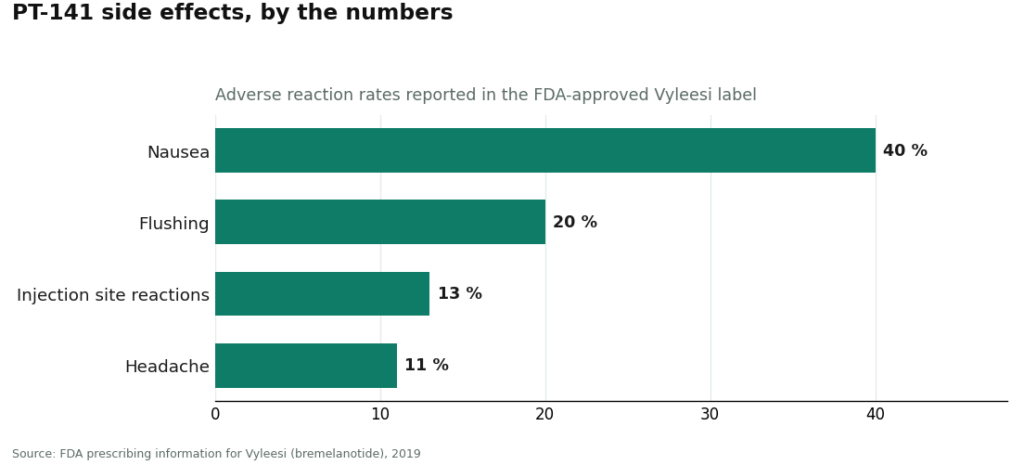
Most users and the clinical trial data put the effects at roughly 6 to 12 hours, with the strongest window landing around 2 to 4 hours after a subcutaneous injection. That range shifts depending on dose, your own metabolism, and body composition. Nausea, the most commonly reported side effect, tends to show up within the first hour and usually fades before the arousal effects do, which is a genuinely inconvenient bit of timing.
Does PT-141 raise testosterone levels?
No. PT-141 works through melanocortin pathways in the brain, not through the hormonal system that controls testosterone production. People sometimes mix it up with peptides like kisspeptin or gonadorelin, which actually do interact with hormone signaling. If low testosterone is the real problem, PT-141 isn’t the tool for it, and that distinction matters if you’re troubleshooting low desire alongside an actual hormone deficiency.
Where can I actually get PT-141 without buying something sketchy?
The FDA-approved path is a prescription for Vyleesi through a licensed prescriber, and that’s the cleanest legitimate option available. A compounding pharmacy route, the kind offered by physician-supervised services like FormBlends, can also get you an accountable, tested product as long as a prescriber is genuinely involved. What you want to steer clear of is any website selling PT-141 as a “research chemical” with no prescriber, no COA available on request, and no real accountability, and as this article shows, that’s a surprisingly large chunk of the market.
References
- Two randomized Phase 3 trials (RECONNECT program) of bremelanotide for HSDD in premenopausal women; roughly 1,267 randomized; statistically significant but modest improvements in desire and distress. Kingsberg SA, et al. Obstetrics and Gynecology, 2019. https://pubmed.ncbi.nlm.nih.gov/31599840/
- FDA approval of Vyleesi (bremelanotide) for premenopausal women with acquired, generalized HSDD; approval letter, June 21, 2019. U.S. Food and Drug Administration. https://www.accessdata.fda.gov/drugsatfda_docs/appletter/2019/210557Orig1s000ltr.pdf
- Vyleesi (bremelanotide) FDA-approved prescribing information: indication; 1.75 mg subcutaneous dosing; contraindication in uncontrolled hypertension or known cardiovascular disease; transient blood-pressure increase and heart-rate decrease; adverse reactions including nausea 40%, flushing about 20%, injection site reactions about 13%, headache about 11%; focal hyperpigmentation with frequent dosing.
- Bremelanotide mechanism (melanocortin receptor agonist, predominantly MC1R and MC4R), approval status, route, dosing, and common side effects. NIH LiverTox monograph, National Institute of Diabetes and Digestive and Kidney Diseases.
Written by Rafael Farrell, science reporter. Reviewing the trials and labels directly. Last reviewed June 2026.
For background only. Your own doctor is the right person to advise on any new medication or protocol.
